Medical Headset Power Supply
We partnered with a pre-seed startup to help build part of their medical device, and ended up redefining the architecture before we ever prototyped. They had a founding engineer who needed to focus on the delicate medical sensors and microcontroller, and we were to handle the power supply and battery. This device was a type of headset that made sensitive measurements on something in the eye (don't ask us what exactly it did, we're engineers not doctors), and would usually sit on a wall mount until the patient put it on.
This project had tight restrictions on board size and weight, and wasn't so tight on costs. To fit in the established form factor, we were told the entire power system and battery had to fit in a volume at least as small as 60mm x 150mm x 40mm, and weight less than 12oz. The circuit had to output a steady 5V @ 150mA from battery and mains power. These were our general limiting factors.
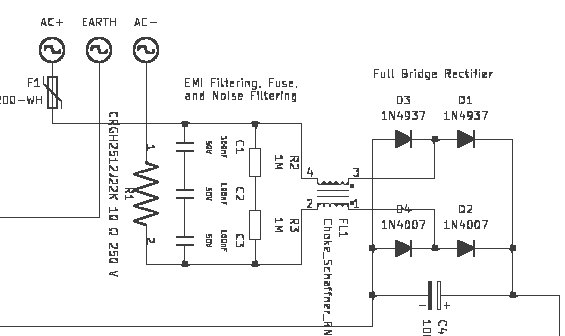
Power supply design is a well-established field and seems simple to many young engineers. Perfecting the output voltage and current, however, is a more precise art where the parameters of each component must be finely tuned. A proper battery could basically feed right into the main circuit with few intermediate steps, but if connected to wall power, a larger circuit would be necessary, along with hefty transformers, capacitors, and a battery charging IC that adds complexity. The allotted space was getting cramped.
At this point we alerted the client that the current system requirements were unrealistic and bound for failure. We explained to the CEO that in a power supply, components run large due to high current ratings, and with a battery attached it would be astronomically expensive to design a system to fit in their tight dimensions. So we immediately negotiated a compromise where they would extend the size of the power module, and most of our AC-to-DC converter circuit would live in a wall-mounted charging station, and not on the headset.
This compromise freed up their headset to be lighter and more mobile, and allowed their charging station to be more robust. Our final version powered the device consistenly and passed the startup's internal safety review, and went on to power an MVP shown to investors.